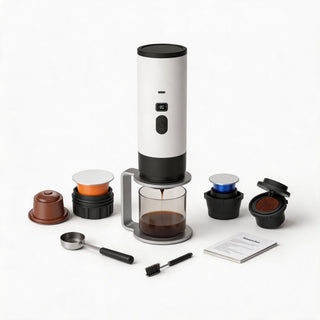
Capsules keep travel brewing tidy; ground coffee gives you more choice. A portable espresso maker that takes both can be useful, provided its water and power requirements suit where you are going.
The Yozcoffee portable espresso maker accepts compatible NS capsules and includes a basket for ground coffee. It has a battery and temperature display and USB Type-C charging. Confirm the exact capsule format and water-heating instructions before packing.
Plan the whole drink before packing: compatible coffee, the right holder, hot water, power and a cup. Include a way to rinse and dry the removable parts.
What makes a portable espresso maker useful?
Check which accessories your chosen coffee format needs. You may be able to leave the unused capsule holder or ground-coffee basket at home.
The display lets you check the listed battery and temperature information before brewing. For charging, use a USB-C power source that meets the supplied instructions.
At 65 mm across and 240 mm tall (2.56 × 9.45 inches) it is narrow, not pocket-sized. That is roughly the footprint of a 750 ml water bottle. Measure the bottle sleeve or drawer you intend to use before ordering. Give it a padded slot too — loose among keys and cables, the control on the front is the part that gets pressed.
Capsules or ground coffee: which should you pack?
Choose your coffee format before the trip. Capsules reduce measuring and cleanup; ground coffee means packing the basket and handling loose grounds.
| Choose | Best when | What to plan for |
|---|---|---|
| NS capsules | Speed and low mess matter most | Confirm the capsule format and count out one per day, plus two spares |
| Ground coffee basket | You want to choose your own coffee | Pre-dose into a sealed tin; expect a rinse and a brush after each brew |
Capsules can simplify brewing in an office or hotel. Drop an NS capsule into its holder, brew, and lift the used one out once it has cooled — the grounds stay contained in the capsule. The catch is that "capsule" describes a dozen incompatible shapes. Use the NS format named on the product page rather than assuming the pods in your kitchen drawer will seat. If capsules are the whole reason you are buying, the capsule machine guide goes further into formats and what they cost per cup.
Ground coffee is the better choice when you have a roast you like. Pre-dose 15–18 g portions into a small sealed container before you leave; that keeps the setup compact and stops you doing math in a hotel bathroom. Do not travel with grounds sitting in the basket. Coffee migrates into the threads and seals during transit, and the holder then refuses to seat properly. If you would rather grind on the trip, a rechargeable grinder that charges from the same cable keeps the packing list short.

A five-step travel brewing routine
1. Charge before you pack
Charge before departure and check the display. If you plan to use a power bank or car charger, confirm it meets the machine's requirements. Keep the port dry.
2. Bring the right coffee and a hot-water plan
Pack NS capsules or ground coffee with the matching holder. The instructions describe adding hot water to the tank, so confirm the hotel, campsite, van or office has a source you can use safely. A full battery is not a kettle.
For camping, distinguish battery charging from water heating. If you need a separate 400 ml travel kettle with fixed temperature settings, check its power requirements too. Do not assume that a power bank can operate a heating appliance simply because it can charge the brewer.
3. Load one brewing option
Fit the correct holder and keep rims and threads clear of grounds. If a part will not seat easily, stop and check the assembly instructions rather than forcing it.
4. Add water, assemble, and brew
Set up on a stable surface and follow the manual's filling and assembly order. Keep hands away from the outlet and hot parts during brewing.
What comes out is a short, concentrated coffee from a portable extractor. There is no steam wand, so a flat white or a cappuccino needs milk heated and foamed separately — the five ways to froth milk without a steam wand cover what actually works with a handheld frother or a jar.
5. Cool, rinse, and dry
Let the hot parts cool before opening the coffee holder. Lift out the capsule or knock out the grounds, rinse the coffee-contact parts as directed, and run the brush around the small edges where fines collect. Everything should be dry before it goes back in a bag.
Wash only the removable parts approved in the care instructions. Keep the powered body and charging port away from water.
Using it at the office without taking over the kitchen
At work, keep the necessary holder, coffee and cleaning brush together. Leave washed pieces out to dry before returning them to storage.
Capsules are the tidier option on a workday, and it is worth being honest that ground coffee in a shared kitchen creates about ninety seconds of extra work. Do that work. A wet basket left in the sink with grounds around the drain is how a personal coffee habit becomes an office complaint. For a longer look at what survives a shared kitchen, the office desk brewer comparison covers the alternatives.
The narrow format may suit a small kitchen or occasional coffee at work. Compare cycle time and capacity if you need several drinks in succession. Milk preparation is a separate consideration.
Two other limits are worth knowing before a trip rather than during one. It brews a short shot, not a 350 ml mug of filter coffee, so a morning that ends in a big mug means several cycles or a lot of added water. And it has no heater, so a destination with no kettle, no dispenser and no thermos leaves you holding a charged machine and cold water. The wider travel brewing range covers the filter-coffee side for the trips where that is the better answer.
The routine in short
Charge, choose capsule or grounds, add hot water, brew upright, rinse. Five steps, about four minutes, repeatable in a hotel room at 6 a.m. If a compact 51 mm ground coffee basket with a capsule adapter sounds closer to what you want, that model handles the same job with a larger dose.
Choosing between portable brewers is a separate question, and it turns on water, power and coffee format rather than on any one machine. The portable espresso maker buying guide runs those checks across capsule, grounds and hand-pumped models and weighs the full kit — grinder, kettle, cables and adapters — rather than the brewer on its own.
Frequently asked questions
Can this portable espresso maker use both capsules and ground coffee?
Yes. The product page lists NS capsule compatibility and includes a separate ground coffee basket. Each coffee format has its own holder, and you swap the holder rather than the machine.
Does it charge with USB-C?
It uses USB Type-C charging. Check the supplied instructions for the required electrical output before choosing a wall adapter, car charger or power bank.
Does the brewer show battery level and temperature?
The listing describes a front display for battery level and temperature. Use it alongside the operating instructions before starting a brew.
How large is it?
65 × 240 mm, or 2.56 × 9.45 inches — close to a slim 750 ml water bottle. Measure the drawer, bag pocket or case you plan to use rather than trusting the word portable.
What comes with the portable espresso maker?
Capsule holders, a ground coffee basket, a coffee container, a scoop and a cleaning brush. Package contents change, so check the live product page before ordering if a specific accessory matters to you.
Can it make milk drinks?
It can brew the coffee base, but a model without a steam wand needs a separate method for heating and foaming milk. Follow the instructions for the frother or heating vessel you use.