The portable coffee maker vs travel espresso maker choice starts with the drink you want. A travel espresso maker suits a short concentrated coffee or an Americano base; a filter brewer is convenient for a longer mug. Then compare the supporting equipment each needs.
Confirm the heating function separately from the power source. Then compare the complete kit, including the cup, coffee, water and cleanup supplies.
Key Takeaways
- Choose a longer filter drink or a concentrated pressure-brewed serving first.
- A stronger gravity-filter recipe does not turn it into espresso.
- Compare complete kits, including the water source and coffee format.
What changes when you switch brew styles
| Decision | Portable coffee maker | Travel espresso maker |
|---|---|---|
| Typical drink | 250–350 ml of filter-style coffee | 25–60 ml, concentrated |
| Serving pattern | One mug per cycle | One small cup per cycle; refill and reload for a second |
| Coffee format | Ground coffee, or whole beans plus a grinder | Compatible capsules, a ground-coffee basket, or both |
| Brewing force | Gravity, immersion, or a controlled pour | A hand pump or a motorized pump |
| Potenza | None, two AAA cells, or USB-C, depending on the design | Your forearm, or a rechargeable pump |
| Hot water | Supplied separately, almost always | Supplied separately on most models — read the listing |
| Pulizia | Filter, dripper, cup, and the grinder if you carry one | Basket or capsule holder, seals, outlet, cup |
| Best fit | You want a mug and few things to charge | You want a short drink from a narrow body |
Compare the packed pouch and the finished serving. A slim brewer can still need several accessories, and a small drink may require repeated cycles.
Four ways to build the travel setup
| If you want... | Consider | What it changes |
|---|---|---|
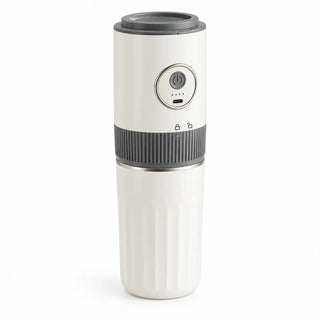
| Fresh-ground filter coffee from one stacked tube | 4-in-1 electric grinder and brewer | Grinder, reusable 304 steel filter, brewer and a 350 ml cup share one body. Hot water still comes from elsewhere. |
| An assisted pour without learning kettle technique | Automatic pour-over coffee maker | Runs the rotating pour for you at 120, 140 or 160 ml. Two AAA cells, a cup and hot water are on you. |
| A complete manual kit that stays organized | 6-piece portable pour-over set | Hand grinder, pouring kettle, reusable dripper, cup, bean canister and scoop in one fitted case. |
| A way to actually heat the water | 400 ml portable electric travel kettle | Four preset temperatures from a corded 300 W kettle. Check plug type, voltage and house rules first. |
Choose the drink before the device
Portable coffee maker is a broad category that includes drippers, presses and integrated units. In this comparison, filter-style options suit longer drinks, while pressure brewers make a shorter, concentrated coffee.
Portable espresso designs vary in dose, pressure mechanism and heating. Check the exact model's capabilities and expect a different workflow from a countertop machine. The explanation of bar rating quoted on home machines clarifies why a pressure number alone does not establish performance.
Choose the format closest to your usual drink. If you add milk, check how you will prepare that separately.
Compare the Whole Travel Brewing System
Measure everything that leaves the house
Lay out every piece each option requires. Include filters or holders, the cup, any grinder and a way to heat water; some pieces may already be part of your travel kit.
The Yozcoffee 6-piece portable pour-over set keeps a ceramic-burr hand grinder, a 250 ml pouring kettle, a dual-layer 304 stainless dripper, a 280 ml steel cup, a 25 g bean canister and a scoop inside a fitted 36 × 21.5 cm EVA case. The fitted case keeps the pieces together but occupies more space than a single dripper. Its kettle pours hot water. It does not make hot water.
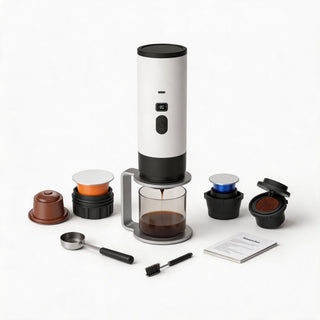
For a narrower vertical footprint, the Yozcoffee portable capsule espresso maker is roughly 65 × 240 mm, about the size of a large water bottle, and carries holders for compatible NS Original-style capsules, a reusable ground-coffee basket, a bean container, scoop, brush and a USB-C cable. Check the body against your bag's available space, and pack accessories clean and dry.
Settle the hot-water plan
Before going further, check whether the device heats water.
The Yozcoffee portable espresso maker spends its battery on a motorized pump and a display that reports charge level and water temperature. It reports that temperature; it does not raise it. The 6-piece manual set has the same gap, since its 250 ml kettle has a 4 mm gooseneck spout built for placing water on a coffee bed rather than for boiling.
Ask the hotel about water-heating facilities before relying on them. For a road trip, an insulated bottle may provide hot water for a stop, but check its temperature before brewing. For flights or rail, consult the carrier's current battery and appliance rules and pack the brewer clean and empty.
Where you have a working outlet and know the local standard, the Yozcoffee 400 ml portable electric travel kettle delivers 45 °C (113 °F), 60 °C (140 °F), 80 °C (176 °F) or 100 °C (212 °F). It is a corded 300 W appliance rather than a battery kettle, so it stays plugged in while heating or holding temperature, and it needs the destination's voltage and plug type to match.
Confirm where the required hot water will come from. If the destination cannot provide it, consider permitted heating equipment or a brewing method that suits the facilities available.
Decide how coffee travels with you
Ground coffee is the flexible option, since it works in a dripper and in any espresso maker with a ground-coffee basket. Weigh portions at home rather than carrying a scale and an open bag: 15 g per brew at roughly a 1:16 filter ratio means 240 g of water, and five sealed portions cover a working week without a single decision at 6:40 a.m.
Whole beans give you fresh grinding and more adjustment, but add a grinder to the bag. Compare the complete weight and effort with sealed pre-ground portions.
Capsules keep the grounds contained, although the brewer still needs cleaning. Check compatibility separately: capsules come in different formats. Confirm the exact capsule family before you buy, and pack used ones in a sealed bag until you find a trash can, to keep residual liquid away from your belongings. A dual-format machine gives you a way out when the local supermarket stocks the wrong system — the trade-offs between the two formats are worked through in this capsules-or-grounds comparison.

Count the powered parts and the backup plan
A manual pour-over setup has few moving parts. Hot water, coffee, an intact filter, and you have a cup. The cost is your hands doing the grinding and the pouring.
A rechargeable pump reduces manual work but needs charging and dry storage. Use the specified cable and power source, and test the number of brews you expect to make.
Use published battery figures as a starting point and test with your dose and grind. Pre-ground coffee is a useful backup only if the brewer accepts it without the grinder operating.
Make cleanup part of the packing decision
Paper filters contain the used grounds. Reusable mesh needs more rinsing and drying, while the grinder usually needs dry brushing. Include that work in the comparison.
An espresso maker concentrates the mess into a smaller space, which is not the same as less mess. Grounds pack hard into the basket and want emptying while they are still warm; residue collects around the seals and the outlet, and left there for a week it goes rancid. Let the parts cool, take out only the components the manual says are removable, and rinse those. The powered body and the USB-C port stay dry.
Let washed parts dry before closing the pouch. A clean cloth and a ventilated bag can help when you need to pack soon after brewing.
Match the brewer to the kind of trip
| Trip | Better starting point | Reason |
|---|---|---|
| One-bag city break | Slim travel espresso maker | Narrow body, one short serving, cafés for everything else |
| Hotel work week | Automatic pour-over or the 4-in-1 grinder-brewer | Room kettles make filter coffee easy; you are unpacked for five days |
| Road trip | 6-piece pour-over set or the 4-in-1 grinder-brewer | The car absorbs the case and the cup volume |
| Office commute | Automatic pour-over or the 4-in-1 grinder-brewer | Grinding noise, hot water and sink access decide this, not size |
| Backpacking | Bare dripper with pre-ground coffee | Nothing to charge and 60 g in the pack instead of 700 g |
| Two people sharing | Pour-over or a larger manual brewer | One brew instead of four short extraction cycles |
For a couple who both drink large coffees, a single travel espresso maker turns breakfast into a loop of refilling, reloading and rinsing — four cycles, twenty minutes, and the first cup is cold by the end. For one traveler who wants a fast short coffee, a six-piece kit is more equipment than the job needs. The wider comparison of formats and capacities sits in the portable coffee maker buying guide.
A packing checklist based on what you drink
Pack a portable coffee maker when you want:
- A 250–350 ml mug of filter-style coffee.
- Manual reliability, or fresh grinding on longer stays.
- Flexibility between ground coffee and whole beans.
- One brew cycle that serves a full cup.
- Fewer powered parts between you and breakfast.
Pack a travel espresso maker when you want:
- A short, concentrated drink.
- Capsule speed, or a 7–10 g ground dose.
- Pump pressure in a body the width of a water bottle.
- A base for an Americano or a milk drink you finish separately.
- A routine built around one person and one small cup.
Make one drink at home with the exact pieces you plan to take. Check that they fit, operate together and pack away after cleaning.
Which should you pack?
Choose by drink style and the routine you are willing to carry out. Filter and espresso formats vary in power, water and cleaning requirements, so compare exact models. The coffee anywhere range includes both approaches.
Compare the integrated grinder-brewer, automatic pour-over and manual set by the drink and packing needs described above. If hot water is the missing part, confirm a suitable heating source before changing the brewer.