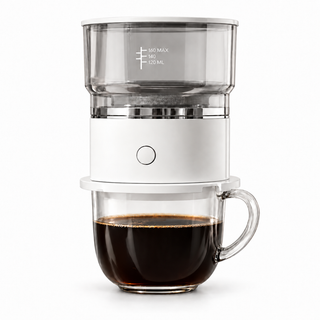
For pour over at work or while traveling, an automatic pouring mechanism can take care of the water pattern. You still need a suitable mug, hot water and somewhere to rinse the filter.
The Yozcoffee portable automatic pour-over coffee maker uses a rotating water tank and a reusable 304 stainless steel filter. Add ground coffee and separately heated water, then start the cycle. This portable pour-over coffee maker is intended for a small filter-coffee serving.
It does not heat water, grind beans, or make espresso. It is an automated pour, not an all-in-one grinder-and-brewer, and the price reflects that division of labor.
Key Takeaways
- This rotating dripper needs separately heated water.
- Two AAA batteries power the pouring mechanism, not a water heater.
- Check the cup fit and rinse the reusable mesh after brewing.
How the automatic rotating pour works
This brewer moves the water tank to repeat the pour. That can be convenient when you do not want to control a kettle throughout the brew.
The sequence:
- Add medium-fine grounds to the reusable metal filter.
- Pour hot water into the Tritan tank, stopping at the 120, 140 or 160 ml mark.
- Seat the brewer over a cup that will hold it steady, on something flat.
- Press the front button.
- Let the cycle run out, then lift it off and clean the filter.
The rotating tank repeats a pouring pattern. Grind, dose and starting water temperature still affect the result, so record those when adjusting the recipe.
Product details that affect the routine
| Feature | Product specification | Practical effect |
|---|---|---|
| Water tank | Tritan with 120 / 140 / 160 ml markings | Three fixed starting volumes for a single small cup |
| Filter | Reusable 304 stainless steel fine mesh | No paper to pack; heavier body, some fines in the cup |
| Power | 2 × AAA batteries | Cordless; batteries are not included |
| Brew cycle | Approximately 150 seconds | Short enough to run while you get dressed |
| Body | Food-grade ABS | Compact white unit, one button, nothing to set |
| Size | 100 × 101.5 mm assembled | Fits a desk drawer, a cabinet shelf or a packing cube |
| Net weight | Approximately 180 g without batteries | Lighter than most travel mugs |
The tank stops at 160 ml, and the cup will hold less than that. Grounds retain roughly 2 g of water per gram of coffee, so a 10 g dose keeps about 20 ml back. Plan for a 140 ml drink from a 160 ml fill.
A practical starting recipe
Medium-fine is the grind the product page starts you on. From there it is a ratio and a taste test. These doses are starting points rather than fixed requirements:
| Water mark | Starting coffee dose |
|---|---|
| 120 ml | 7–8 g |
| 140 ml | 8–9 g |
| 160 ml | 9–10 g |
That lands between 1:15 and 1:17, the same window most filter recipes live in — the ratio guide covers how to move inside it when a bag tastes wrong at both ends.
Follow the brewer's temperature guidance and remember that it does not heat or hold the water at a set temperature. Cooling depends on the water volume and conditions. A 400 ml travel kettle with four temperature settings can help with repeatable preparation where a suitable power supply is available.
Use the same beans, dose and water mark for the first few cups. Adjust the grind if the taste or flow calls for it:
- Thin and sharp, cycle finished early — grind a step finer.
- Water still sitting on the bed at the end, cup dry and bitter — grind a step coarser.
- Balanced but too strong — drop the dose by 1 g.
- Balanced but weak — add 1 g, up to what the filter holds comfortably.
A stepped grinder makes this much easier to track, since you can count your way back to what worked. A cordless grinder with numbered settings pairs neatly with a battery brewer for exactly that reason.
What the stainless steel filter changes
The reusable mesh reduces the paper filters you need to carry. That can be convenient at a desk or on a trip, provided you have a way to clean it.
Metal mesh allows more oils and fine particles into the cup than paper. Expect a fuller texture and possibly some sediment; choose paper filtration instead if you strongly prefer a clearer drink.
If you specifically like the crisp, low-sediment profile of paper, this is the wrong brewer. Do not improvise by pressing a paper cone into the metal basket unless the manufacturer lists a compatible size — it changes the flow rate and can push water over the rim during the rotating pour. The manual pour-over range covers the paper-filter side properly.
Where a portable coffee maker earns its space
At the office
At a desk, leave a stable space for the brewer and keep liquid away from electronics. You still need hot water and somewhere to rinse the filter. Store the brewer dry between uses.
In a hotel room
Your filter and your recipe come with you, which is most of what makes hotel coffee tolerable. Check the room first, though: an in-room kettle that has boiled a hundred tea bags will put its own flavor in the water, and some rooms have no cup wide enough to hold the brewer steady. Pre-measured doses keep the whole thing to two minutes.
For camping and road trips
Its compact size may suit a travel bag, but count the whole kit before deciding what to carry. Include batteries, a cup, water-heating equipment and a way to collect used grounds. Keep the motor housing dry.
In a compact kitchen
The 100 × 101.5 mm footprint suits a narrow counter or one shelf. It works best for one person who wants a single filter coffee rather than a carafe. Two people means running two cycles back to back, about six minutes total, which is slow enough to be irritating on a weekday. If two cups is the normal morning, a carafe brewer from the pour over coffee makers and drippers range fits that routine better than a second cycle.
Cordless does not mean rechargeable
The rotating mechanism runs on two AAA batteries, and the product page says they are not included. There is no USB charging. Pack spares if the brewer is your only coffee on a trip, and follow the battery-removal guidance before long-term storage.
The batteries power the movement of the tank. They do not heat the water, so plan a separate hot-water source.
Cleaning the filter and protecting the motor body
Clean removable coffee-contact parts soon after brewing, once they are safe to handle.
- Let the filter cool, then knock the spent grounds into a trash can or compost.
- Separate the tank and the filter from the main body.
- Rinse the mesh from both sides so fines do not dry inside the weave.
- Wash only the parts the instructions identify as washable.
- Wipe the motor body with a lightly damp cloth. Do not put it under a tap.
- Let every part dry fully before stacking or packing it.

If flow slows, check the mesh for residue as well as the grind. Clean it according to the care instructions, using a soft brush where permitted. Do not clear holes with sharp objects.
Check the cup and package contents before travel
The package lists the brewer, the reusable 304 stainless steel filter and the Tritan tank. It does not list a drinking cup, even though the product photos show the brewer sitting on a clear one. Unless your order confirms otherwise, bring your own.
The cup matters more than it sounds. The brewer perches on the rim, so a tapered or narrow mug lets it rock, and a 150 ml pour arriving into a tilted brewer ends up on the desk. An insulated mug with a wide, flat rim holds it steady and keeps the finished cup hot for the rest of the morning. Test the pairing at home before the first trip.
Who should choose this brewer—and who should not
It fits if you want:
- One small filter coffee at a time
- The same pour pattern every morning without practicing a kettle technique
- A metal filter instead of a paper habit
- Something cordless for a desk, a hotel or a one-shelf kitchen
- Under 200 g in the bag
Look elsewhere if you need:
- More than one cup per cycle
- Built-in heating or temperature control
- USB recharging
- Espresso pressure or capsule compatibility
- The clean, sediment-free profile of paper
- Manual control over bloom and pour stages
The narrow scope is the product. It automates one pour for one cup and leaves the grinder, kettle and espresso machine to other tools. The rest of the travel and compact brewing range fills in whichever of those you still need.
Try it with your travel mug
The markings and rotating tank help repeat the water delivery. You still choose the dose, grind and starting water temperature.
Before packing it, test a complete brew on the mug you intend to take. That confirms the fit and the serving size.