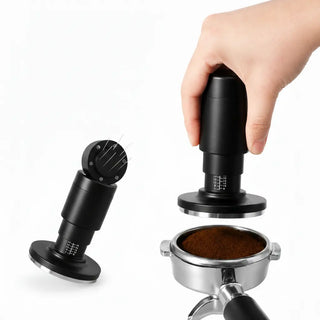
A spring-loaded tamper can help you repeat the pressing step. Check that it fits your basket and lets you press level without an awkward grip.
Check your grinder, dose and distribution first. If tamping remains awkward, a spring-loaded tamper and WDT distributor with magnetic stand keeps those tools together. Confirm the appropriate 51 mm, 53 mm or 58.35 mm size against your basket.
What does a spring-loaded espresso tamper do?
With a conventional tamper, you judge alignment and compression by feel. That works well with practice, but an awkward counter height or unsupported portafilter can make the movement harder to repeat.
The spring adds resistance to the press, but the operating mechanism varies by model. Some tampers click; others reach a stop. Follow the instructions and check whether the design also guides the base level with the basket.
Once the bed is compressed, consistency is more useful than extra force. Keep dose, grind, distribution and basket fit steady when comparing tamping techniques.
Why espresso puck prep affects channeling
Uneven density, clumps and gaps can give water easier paths through the puck. Tamping is one part of addressing that uneven flow.
Watch for spraying or uneven flow if you use a bottomless portafilter. Compare those signs with taste and shot measurements before deciding what to change.
A spring-loaded design can make the load more repeatable, and a leveling collar may help with alignment. It does not correct clumps or an unsuitable grind, so keep checking the earlier preparation steps.
Spring-loaded tamper vs traditional tamper and distributor
Traditional flat-base tamper
A conventional flat tamper is enough when it fits the basket and you can use it consistently. Check fit and support before assuming a spring mechanism is the missing piece.
Spring-loaded or calibrated tamper
The spring can provide a consistent feel during the press. Whether that helps depends on your current technique and the design of the tamper.
WDT needle distributor
Different stage, different job. WDT happens while the coffee is still loose — fine needles pass through the bed, break up clumps and redistribute dense pockets. The Yozcoffee set pairs the tamper with a needle distributor on a magnetic stand, which keeps the two tools separate in use but together in one place.
Step-by-step espresso puck prep with a spring-loaded tamper
- Dry the basket. Wipe out water left from the last purge so grounds do not stick in wet patches along the wall.
- Weigh the dry dose. Use the range recommended for your basket and keep it fixed while testing. A coffee scale with a timer helps record dose and yield; basket diameter alone does not determine a suitable gram dose.
- Transfer the grounds cleanly. A 58 mm aluminum dosing cup can contain grounds during transfer. Confirm the cup’s rim fit and grinder clearance before choosing it for your basket.
- Distribute before tamping. Take the needles through the full depth of the bed, not just the top layer, then finish level. Avoid hard side-tapping afterward — it reopens gaps at the basket wall, which is the last place you want a gap.
- Settle the bed lightly. One gentle vertical tap drops the grounds below the rim. Slamming the portafilter down cracks what you just built.
- Support the portafilter. Ears resting on something level, handle vertical, basket not rocking.
- Press straight down. Let the spring reach its stop. No hard twist at the end and no second leaning press to “make sure”.
- Inspect and brew. Brush the rim clean, lock in, and start the shot without knocking the group.
Repeat the same preparation while you compare shots. Change the brewing recipe separately.
How to choose a 51mm, 53mm, or 58.35mm tamper
Measure the basket, not only the machine name
The label on a portafilter does not always match the inner diameter of the basket inside it, and an aftermarket basket can differ from the one the machine shipped with. Measure the opening with calipers, or check the basket manufacturer's spec, before you order.
- 51 mm: compact home machines and many portable espresso makers.
- 53 mm: the Breville and Sage 870 or 878 family, among others.
- 58.35 mm: a closer-fitting option for some nominal 58 mm baskets. Actual clearance depends on the basket’s internal diameter; verify the fit instead of assuming a fixed gap.
An undersized base can leave loose grounds near the wall; an oversized one can bind. Basket dimensions vary, so confirm compatibility for the exact base and basket.
Check dose and headspace too
Stay within the basket's intended dose range and check headspace using the manufacturer's guidance. A mark on the wet puck after brewing does not, by itself, establish whether the original dose was correct.
Spring-loaded tamper troubleshooting
The shot still runs too fast
Hold dose, target yield and preparation steady, then make a small grind adjustment if the shot runs fast and tastes thin. If adjacent settings jump past the result you need, assess the grinder’s usable adjustment range. A 35-setting burr grinder provides numbered steps, but setting count alone does not prove suitability for every espresso basket.
The bottomless portafilter still sprays
Look at distribution depth first, then at gaps along the basket wall, then at whether the portafilter got knocked between tamping and locking in. Confirm the basket is clean; old coffee dried into the perforations changes flow more than people expect.
There is a loose ring around the puck
Check whether the base is too small for the basket. Measure or consult the basket specification before changing your tamping pressure.
The puck is level but the shot tastes uneven
If tamping is consistent, check the beans, grind, dose, temperature and brew ratio. Work through them separately.
Is the Yozcoffee spring-loaded tamper worth it?
It suits a home barista who already weighs the dose and wants the tamping step to stop being a source of doubt. Stainless steel, a WDT needle distributor and a magnetic stand in the same set, sized 51 mm, 53 mm and 58.35 mm.
Buy an espresso-capable grinder and a scale before adding a specialty tamper. If you prefer a single tool with a wooden handle, compare the constant-force walnut tamper.
Related espresso guides
- How to Reduce Channeling and Improve Espresso Extraction
- Espresso Tamper Guide: Choosing the Right Size for Consistent Shots
- Home Espresso Workflow Checklist for Cleaner Puck Prep