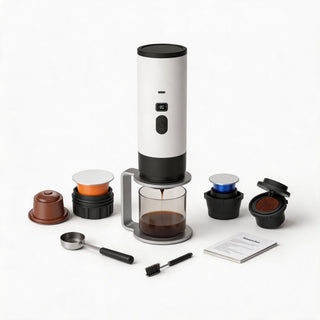
Compare a travel coffee maker with everything it needs beside it. A small device may still require a kettle, grinder and cleaning kit, so the packed system matters more than the brewer's headline weight.
Start with the facilities available: a hotel kettle, campsite stove, office hot-water tap or vehicle power. The seven checks below help you work out which brewing format fits those conditions.
First, match the brew method to the trip
Start by comparing these brewing formats.
| Brewer type | Typical drink | What it usually needs | Best fit |
|---|---|---|---|
| Pour-over dripper | Clean filter coffee, 250–350 ml | Hot water, grounds, a mug, paper or a steel mesh | The lightest kit that still tastes like proper coffee |
| Immersion or press brewer | Heavier filter coffee, 300–400 ml | Hot water, grounds, room to stir and press | Hotel and office mornings where technique is the last thing you want |
| Manual portable espresso maker | 25–60 ml of concentrate | Hot water, fine grounds or capsules, 40–60 hand pumps | Short strong drinks with nothing to charge |
| Rechargeable pump brewer | 25–60 ml of concentrate | A charged battery, and on most models pre-heated water | Faster office, hotel and road-trip routines |
| Self-heating portable machine | Hot espresso-style coffee from cold water | Real battery capacity, charging time, and packing room | Trips where hot water genuinely isn't available |
Choose drink size and hot-water access first. A device for a short concentrated coffee may not suit someone who wants a full mug of filter coffee.
Seven Checks Before Buying a Travel Brewer
Start with the cup you actually drink
Decide whether you want a short shot or a longer cup. That narrows the options before you compare individual models.
Different methods ask for different preparation. Portable espresso makers require compatible coffee holders and appropriate grounds; filter brewers need their own grind and water plan. Milk drinks add another step. The side-by-side comparison can help you choose between formats.
Pack the whole routine, not just the brewer
Check the dimensions of the brewer and the space needed for the complete packed kit. Allow protection for fragile parts.
Write out every separate item that has to travel with it:
- Brewer and protective case
- Coffee, capsules, or beans
- Grinder, or pre-ground portions
- Kettle, stove, or an insulated bottle of hot water
- Paper filters or a reusable mesh
- Mug or serving cup
- Scale, scoop, or measuring spoon
- Charger, cable, spare batteries, or a power bank
- Brush, cloth, and somewhere wet parts can sit
Pack a candidate setup into the bag you plan to take. Check protection for fragile pieces and somewhere to put damp parts if you must leave soon after brewing.
Solve hot water before choosing a machine
Confirm the water supply before choosing the machine.
Drippers, presses and most rechargeable pump brewers all begin with water somebody else heated. If the rooms you stay in have no kettle and no dispenser, either buy a brewer with a genuine heating element or pack a 400 ml travel kettle. The kettle looks like the heavier answer and is usually the better one, because it also makes tea and it still works when the brewer's battery is flat.
"Electric", "rechargeable" and "USB-C" do not mean a machine heats water. Plenty of batteries drive only a pump, a display, or a rotating pour arm. The automatic pour-over brewer spins water across the bed on two AAA cells and needs that water already hot. The slim portable espresso maker shows battery level and water temperature on a display, and it too starts from pre-heated water. When a machine heats from cold, the listing says so in plain words. If the listing is unclear, confirm the heating function before buying.
Decide how much battery dependence you will tolerate
A manual brewer avoids battery charging, although you may still need a powered or stove-based water source. Compare the effort of pumping or grinding with the length of the trip.
For an electric model, check these requirements:
- Whether it runs while plugged in, or has to charge first
- Input voltage and current, and whether a car outlet is enough
- Charging time, and heating time if it heats at all
- Realistic brews per charge, not the laboratory figure
- Whether a power bank you already carry can drive it
- Whether spare cells are a standard size you can buy anywhere
Test the brewer, cable, charger and water plan together before departure. For air travel, check the current rules with your airline for the specific device and battery.
Choose coffee for the third morning, not the first
The coffee format changes both the preparation and cleanup.
Capsules keep doses contained but require the exact compatible format. Buy enough before traveling if availability at your destination is uncertain.
Ground coffee opens up the beans and closes down the convenience. Espresso-style brewers want a fine, even grind that a small hand mill can struggle to hold under load; pour-over and immersion are much more relaxed about particle spread, which is why a compact burr grinder is easier to live with on the filter side. If you would rather not carry one, weigh 18 g doses into small sealed pouches at home. Ground coffee is noticeably duller by day four, so this works for a long weekend and falls apart on a two-week trip.
Reusable mesh needs rinsing and produces a fuller texture. Paper makes it easier to lift out the used grounds and usually gives a clearer cup. Choose the routine you can manage on the trip.
Count the time from first scoop to second cup
Compare the finished serving with the drink you want. Tank capacity is not identical to output because grounds retain some water.
Three questions to check before packing:
- How much coffee do I drink in one sitting?
- How long is one full cycle, counting heating and cleanup?
- Can it make a second serving right away, or does it need to cool or recharge?
Traveling alone, a single-cup brewer is efficient. For two, back-to-back cycles plus reheating water often take longer than one session with a 400 ml dripper, and a 1:16 pour-over recipe scales up without any extra hardware. Check cup diameter too. A brewer that only balances on a 75 mm rim may not sit securely on the mug you packed.
Use a measured dose and water amount, and check that the filter seats correctly. Assemble and try the complete setup before leaving.
Plan for a small sink and a damp travel day
Picture the available sink or washing area. Wide openings and removable coffee-contact parts can make cleaning easier when space and water are limited.

Clean approved removable parts after use and dry them before packing. Keep powered components out of water unless the manual explicitly permits the cleaning method.
Check how the case protects glass, seals and exposed controls. Fragile components need room and padding within the packed bag.
Which portable coffee maker fits your trip?
| Your usual situation | Prioritize | Watch out for |
|---|---|---|
| Hotel with a kettle | Compact dripper, press, or a pump espresso maker | Capsule supply, and a sink you can't rinse a dripper in |
| Hotel with no reliable hot water | A self-heating model, or a 400 ml travel kettle | Charging time, plug type, and the extra 300–500 g |
| Car or RV trip | Rechargeable or self-heating brewer, stored so it can't roll | Loose parts and 12 V adapters that don't deliver enough current |
| Camping near a stove | Manual dripper, press, or hand-pumped espresso maker | Water budget, grounds disposal, and anything breakable |
| Ultralight backpacking | A 60 g manual brewer and pre-ground coffee | Heavy mugs, grinders, and accessories you carry but never use |
| Office desk | A tidy single-cup brewer whose parts rinse in 30 seconds | Noise, drips near a keyboard, and monopolizing the shared sink |
Choose for the trips you actually make. A lightweight hiking kit and a comfortable hotel setup may justify different pieces.
Run one travel morning at home
Write down the water source, cup, waste plan and charging needs before buying.
Choose the setup with requirements you can meet throughout the trip. The travel and portable brewing range includes options with different brewing and power needs.
More on This Brewing Routine
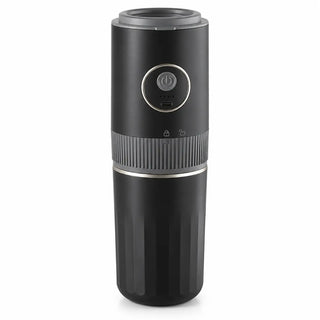
The portable grinder-and-brewer kit combines electric grinding with a reusable filter and cup. Include a separate hot-water source in the packing list.