An awkward kettle can make pour over harder than it needs to be. If the stream arrives in sudden splashes or you keep guessing the temperature, those are useful reasons to consider a different one.
An electric gooseneck kettle combines temperature selection with a spout designed for a controlled pour. It helps you repeat those parts of the recipe while you work on grind and dose.
Here is how to judge the spout, capacity and controls for your usual brew.
Quick answer: who needs an electric gooseneck kettle?
It is worth considering if you regularly brew pour over and find your current kettle difficult to control. Think about whether temperature selection and a gentler stream would solve a problem you actually notice.
If your brewer handles its own water delivery, a gooseneck may add little. If grind is the recurring difficulty, compare a burr grinder with a proper adjustment range before changing the kettle.
Compare Temperature, Pouring Control and Capacity
Why water temperature changes the taste of coffee
Water temperature affects extraction. For filter coffee, 90–96 °C (194–205 °F) is a useful starting range, with room to adjust for the coffee and recipe.
Try the warmer end for light roasts and a little cooler for dark roasts. For tea, follow the guidance for the particular leaves rather than using one temperature for every variety.
Boiling and waiting does work — but the wait is not a fixed number. Cooling depends on the water volume, kettle and room temperature. Temperature control makes the heating step easier to repeat. It is one of several adjustments you can make to a pour-over recipe, alongside dose, grind and pouring technique. The step-by-step how to brew pour over coffee guide sets all four out as a 20 g timing chart.
What the gooseneck spout actually does
A gooseneck spout makes it easier to deliver a small stream and direct it across the grounds. Flow still varies with the kettle, fill level and the angle of your hand.
Practice wetting the bed gently and evenly. If water digs a deep hole or pushes grounds high up the filter, reduce the flow and keep the spout closer to the brewer.
You do not need a beautiful pour. The spout buys you enough control to be sloppy and still land in range while the habit forms, which is most of what separates the gooseneck kettles from whatever is already on your stove.
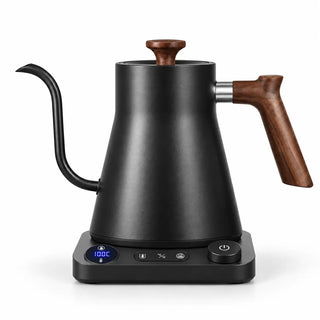
Where the Yozcoffee 0.9L kettle fits at home
A 0.9 L kettle holds enough water for two 320 g brews with some left for rinsing. Check the usable fill limit and how comfortable the kettle feels at the amount you normally heat.
Check the interior material, temperature controls and safety features listed for the model. The 0.9 L variable-temperature gooseneck kettle is one option to compare for those requirements.
How to use it for a better pour-over routine
Try 20 g of coffee and 320 g of water at 93 °C (199 °F) as a starting recipe. Repeat it a few times before deciding what to adjust.
For that recipe, bloom with about 40 g, checking that the grounds are wet. After 30–45 seconds, add the remaining 280 g in gentle pours. Include the bloom in the 320 g total.
If the cup tastes sour and hollow, compare a slightly finer grind or warmer water. For a dry, bitter finish, try coarser or slightly cooler. Change one thing at a time and record the result. You can brew with a timer running beside the weight to track the recipe as you adjust it.
For the rest of the pour-over setup, a coffee scale with timer keeps dose and water measurements repeatable. If you also need a brewer, the glass pour-over coffee maker includes a reusable steel filter.
What to check before buying a gooseneck kettle
Check the handle, balance and lid clearance as well as the controls. If you can handle a sample, try the pouring position you use at home.
Compare the model’s listed heating power, temperature range and keep-warm controls. Heating time varies with fill volume, starting temperature and power supply; do not assume a three-minute result or a fixed hold duration without a documented specification. Include rinse water when choosing kettle capacity.
For travel, check voltage, power access and packed size rather than assuming every electric kettle will suit the destination. A 550 ml portable travel kettle is another format to compare. At home, choose a kettle that fits the volume and handling needs of your pour-over gear.
The Yozcoffee Smart Gooseneck Kettle 0.9L
The Yozcoffee 0.9 L electric gooseneck kettle lists a 40–100°C temperature range, a digital display and keep-warm controls. These are the documented features to compare; the current listing does not establish a ±1°C accuracy tolerance or a fixed pouring rate.
Compare these features:
- Adjustable target temperature from 40–100°C, with a switchable °C/°F display
- A narrow gooseneck spout for directing water; flow depends on fill level and how you tilt the kettle
- 0.9 L — two 320 g brews, and still balanced when full
- 304 stainless steel interior; clean and dry it according to the care instructions
- Keep-warm control, dry-boil protection and a supplied electric heating base
Choose it for the convenience you will use. If your existing kettle already pours well, a separate thermometer may cover the temperature check.