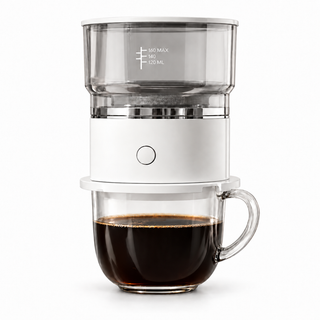
Choose a pour-over brewer for the cup you make most often. A mug at your desk, a carafe for two and a compact travel kit have different capacity and cleanup needs.
Check filter availability and cleanup next. Our pour over coffee makers and drippers include carafe sets, folding drippers and a small automatic brewer, each suited to a different routine.
Compare the brewing routine first
| Routine | Useful format | Check before buying |
|---|---|---|
| One small cup at a desk | Automatic single-cup pour-over | Where the hot water comes from, and the 160ml ceiling |
| Manual brewing into a server | Glass dripper and carafe | Whether you can buy that cone paper locally |
| Travel with fewer disposables | Reusable filter, or a packed kit | Cup opening, packed weight, somewhere to rinse |
| More control over the pour | Manual dripper plus gooseneck kettle | Kettle capacity and permitted heat source |
For a desk: automatic 160ml pour-over
The Yozcoffee automatic pour-over brewer rotates a water tank above a reusable dual-layer steel filter, so the circular pour happens without your hand in it. The tank is marked at 120, 140 and 160ml. Two AAA batteries drive the mechanism, and a cycle runs about 150 seconds.

It does not heat water, and neither the cup nor the batteries are included. Plan a suitable hot-water source and a stable cup. The 160 ml marking is water capacity; finished coffee is smaller because the grounds retain liquid. See the small-dripper recipe guide for dose and fill checks.
For a home counter: glass dripper and carafe
The 400ml glass pour-over set pairs a double-wall glass dripper with a borosilicate carafe. Cone papers are sold separately, and they have to be the right size. Buying a brewer and then discovering its filters are a special order is the most common regret in this whole category, so check that before you check anything else. 400ml is one generous mug or two small cups. Once it arrives, the how to brew pour over coffee guide walks through a 20 g recipe that fits this carafe.
If the material is the main choice left, compare ceramic and glass pour-over brewers by filter type, capacity, preheating and care.
A carafe lets you brew a batch before dividing it between cups. Glass makes the collected coffee easy to see, but adds a piece to wash and protect. A reusable mesh filter usually gives more body and sediment than paper. Choose according to the texture and cleanup you prefer.
For travel: a complete manual kit
The six-piece portable pour-over set keeps a manual grinder, kettle, reusable dripper, cup, canister and scoop in a fitted case. Compare its contents with pieces you already own.

Weigh the whole case before you decide it is the travel answer. It is bulkier than a folding dripper plus a bag of pre-ground coffee, and it still does not solve the hard part of brewing away from home, which is heat. Check the actual hot-water facilities at the hotel or campsite. A collapsible paperless dripper that sits on any cup with a 76-110mm opening may take less bag space than a full case. Check the packed weight and mug fit for the model you choose. The rest of the pour-over range covers both directions.
Before You Choose: Run Through One Complete Brew
At a desk or on a home counter
Place the intended cup or carafe beside your water source. Check filling clearance, whether you can see the scale and where you will put the wet filter afterward. A small nominal capacity can suit one drink but require repeated cycles for two people. Compare the finished serving you need rather than the largest number on the vessel.
For a travel kit
Pack only the parts you will use and test the complete routine before leaving. A rotating dripper automates pouring; a manual set organizes the grinder, kettle and cup. Neither removes the need for hot water. If paper filtration is your preference, confirm the filter shape and pack the correct size.
A kettle supports the brewer; it does not replace it
The 0.9L variable-temperature gooseneck kettle handles heating and controlled pouring. You still need a suitable brewer and filter to make the coffee.

Check the permitted heat sources for the exact kettle. Handle material and appearance do not establish compatibility. Allow enough capacity for the recipe and any rinsing; the 350ml versus 600ml comparison explains that choice. Compare the gooseneck kettle lineup for manual and temperature-controlled options.
How to compare paper and reusable filters
Check how easily you can buy the correct paper filters and whether you have a sink for cleaning reusable mesh. These everyday details can decide which brewer you keep using.
Paper lifts out with the grounds in one motion and goes in the trash. That is its whole advantage, and it is a real one. Steel mesh ends the recurring purchase and the recurring packing, in exchange for a cleaning routine and some fines in the bottom of the cup. You get more of those with a coarse, uneven grind and fewer if your grinder holds a tight particle range. Neither filter is inherently better coffee.
Use one measured starting recipe
Try 15 g of coffee and 240 g of water as a first recipe. Wet the grounds with about 40 g, wait around 30 seconds, then add the rest gently. Record drawdown and taste; timing varies with the brewer and filter.
On the 160ml automatic brewer, scale down rather than pouring in 240 g and hoping. Around 10 g of coffee at the 160ml mark holds the same ratio, and filling past the mark floods the tank instead of brewing stronger. Once three cups in a row taste the same, the ratio guide covers where to move the numbers next.
Water temperature and troubleshooting
Try 92–96 °C (198–205 °F) as a starting range, then adjust for the coffee. Record the kettle setting if you have one. Otherwise, keep filling, preheating and cooling time consistent while you work on the rest of the recipe.
If the cup is weak, check the dose and grind. For a drying taste, compare a gentler pour or a coarser setting. Make one change so you can tell what helped.
Choose by the routine you will repeat
Measure the space, confirm the filters and try to picture cleanup after a normal brew. Choose the design that fits those habits.